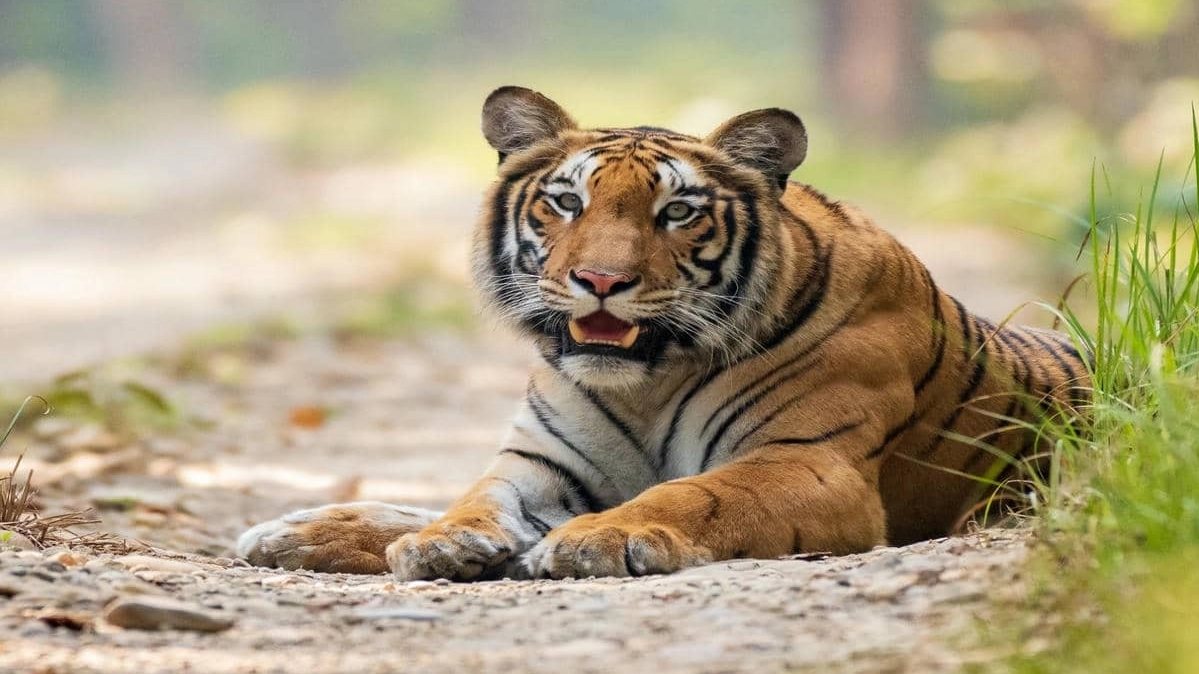
The sub-tropical Inner Tarai lowlands in south-center Nepal are blanketed by the dense forest of the Chitwan National Park. It is located in the Sivalik and Mahabharat ranges. The nine-hundred fifty-two-kilometer square of land touches the landscapes of Chitwan, Makwanpur, Nawalpur, and the Parasi districts of the region.
In the southwestern corner sits the bustling city of Chitwan. It neatly aligns with the Jungle and the Narayani River, one of the largest and deepest rivers in the country that flows through it from the north to the south. This picturesque town is built in the foothills of the Himalayas, offering a view of all three geographical regions at once.
At a time, Chitwan was a dense forest and heavily inhabited by wild animals. Small Tharu communities lived in the forest until the 1950s. ‘Chit’ refers to ‘heart’ in Nepali and ‘wan’ means ‘forest’, so the name Chitwan directly comes to mean ‘the heart of the forest’. The Tharu legends recite that this land of wildlife was once ruled by the Tharu God Chitrasen Baba, whom the local Tharu people worship. They believe back then it was called ‘Chitra van’.
The best way to reach Chitwan is from the city of Bharatpur. You can take a 30-minute-flight from Kathmandu to easily reach it. Buddha Air has six direct flights every day going from Kathmandu to Chitwan. Then, a short and easy car or bus ride will take you there.
The first national park of Nepal, Chitwan National Park was established in 1973. But in the first decades, it was a hunting reserve. In 1984, the national park was listed as one of the World Heritage Sights because of the rare and exotic species of flora and fauna present here. The Rapti river, Narayani river, and Reu river meet amidst the jungle area. Devi Tal, Lami Tal, and Bis Hajaar Tal are some of the hidden gems of the park–lakes that offer a serene jungle experience as an ideal spot for birdwatching.
The best time to visit here is between October and March when the weather lies at its best and clearest. However, if you’re aim is to witness the wildlife particularly, there is a better chance of that from January to March when the 8ft tall grasses are cut down. The Monsoon season here has its own beauty, the lush greenery circles and the abundant Sal trees covering the Jungle and there are possibilities to see unique species of plants and flowers. But the trail for walking as well as for Jeep safari rides gets wet which might not be the safest.
The park is home to more than 50 mammal species, 525 birds, and 55 amphibians and reptiles. One-horned rhinos, Royal Bengal tiger, Asian elephants, four-horned antelope, gharial, golden monitor lizard, gaur, pangolin, sloth bears, and python snakes are some of the rare species that are conserved in the national park.
Activities:
Elephant Safari
Roaming around the jungle from the back of an elephant is a much-admired experience at the Chitwan National Park. You will get a top view of the jungle. But it is limited to either side of the Narayani river as the elephants will not take you across the river to explore the denser forest.
Jungle Walk
For any adventurous heart, the jungle walk is probably the best option to kick in the adrenaline and experience the magnificent wildlife. There will be guides accompanying you throughout the walk and safety measures in case of any wild animal direct encounters will also be explained. While it has its risk walking through a jungle inhabited by so many wild animals, it is an experience of a lifetime. You will get to request the guide to take any doable track that you want to see particularly as well in both sides of the river.
Jeep Safari
They say a Jeep Safari through the jungle is another experience of a lifetime you will always remember. Although it is very different than a walk or an elephant ride. The jeep will take you further through the forest, reaching areas you may have not been able to on your feet.
Canoeing
Canoeing through the Rapti river is yet another experience you will remember. Along with the astonishing view of the tall grasses and the jungle, you will get to spot different wild animals, birds as well as gharials on the river shore.

![TWO DAYS TO RHINO LAND [BHCP]](https://holidays.uat-new.veciq.com/uploads/images/gallery/croppedimage/1589318323-520064.jpg)









![MUKTINATH DARSHAN [BHMDTO]](https://holidays.uat-new.veciq.com/uploads/images/gallery/croppedimage/1579580858-553394.jpg) LUXURY
LUXURY
![TWO DAYS TO PARADISE POKHARA [BHPP]](https://holidays.uat-new.veciq.com/uploads/images/gallery/croppedimage/1584354563-216940.jpg)